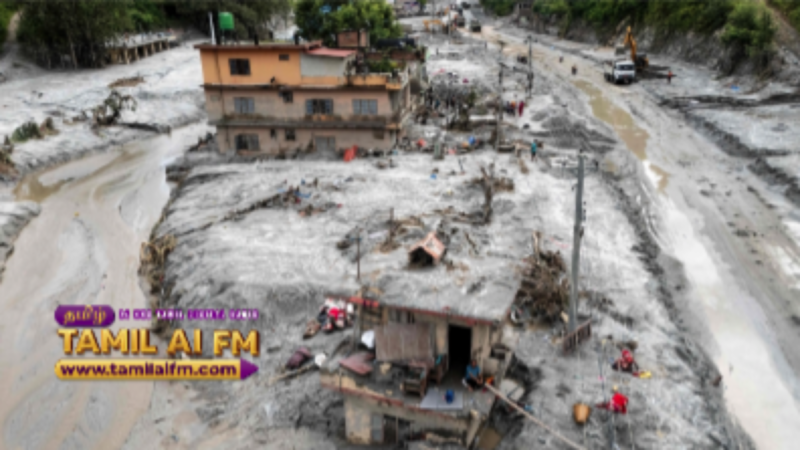
KATHMANDU — When a wall of icy debris from a glacial collapse on the China-Nepal border tore through his village last week, Pemba Chhring Tamang watched the landscape he had known all his life disappear.
“The flood was one like I had never seen before,” said the 57-year-old, rescued from his Himalayan village in Nepal’s devastated Rasuwa district. “It destroyed everything, our homes, our village.”
The August 26 disaster, one of Nepal’s worst climate-linked catastrophes, brought grief but also anger.
“What has Nepal done to deserve this?” asked Tashi Lhazom, a Nepali climate activist and politician.
“It is among the most climate-vulnerable countries, but at the same time, it is also the most climate-friendly.”
The huge wave of debris killed more than 1,200 people and left more than 4,750 missing in Nepal and China’s Tibet region, smashing towns, roads, bridges and multiple hydropower dams.
Rescuers are still searching for survivors and the dead, while helicopters ferry food and medicine to those left with nothing.
While the exact cause of the glacial collapse is unclear, climate change is causing glaciers to melt worldwide, heightening the risk of such disasters.
“We have been hearing news about climate change, and there have been floods before — but never like this,” said Tamang, speaking to AFP in Kathmandu.
Nepal, a largely rural nation of 30 million people that has contributed little to the greenhouse gas emissions driving global warming, says reconstruction could cost “billions” of dollars.
“We are suffering for a crime that we did not commit,” Lhazom said.
Nepali glaciologist Tenzing Chogyal Sherpa said wealthy industrialised countries driving global emissions should accept their role.
“They should take some responsibility, and there should be some accountability,” he said.
Scientists say the warming climate is already altering the risks facing the Himalayan region.
Disaster specialist Saswata Sanyal, at Kathmandu-based International Centre for Integrated Mountain Development (ICIMOD), said the region is warming roughly “at twice the rate” of anywhere else in the world.
“We have seen cascading disasters, like what we saw August 26, where one event triggers multiple events,” he said.